
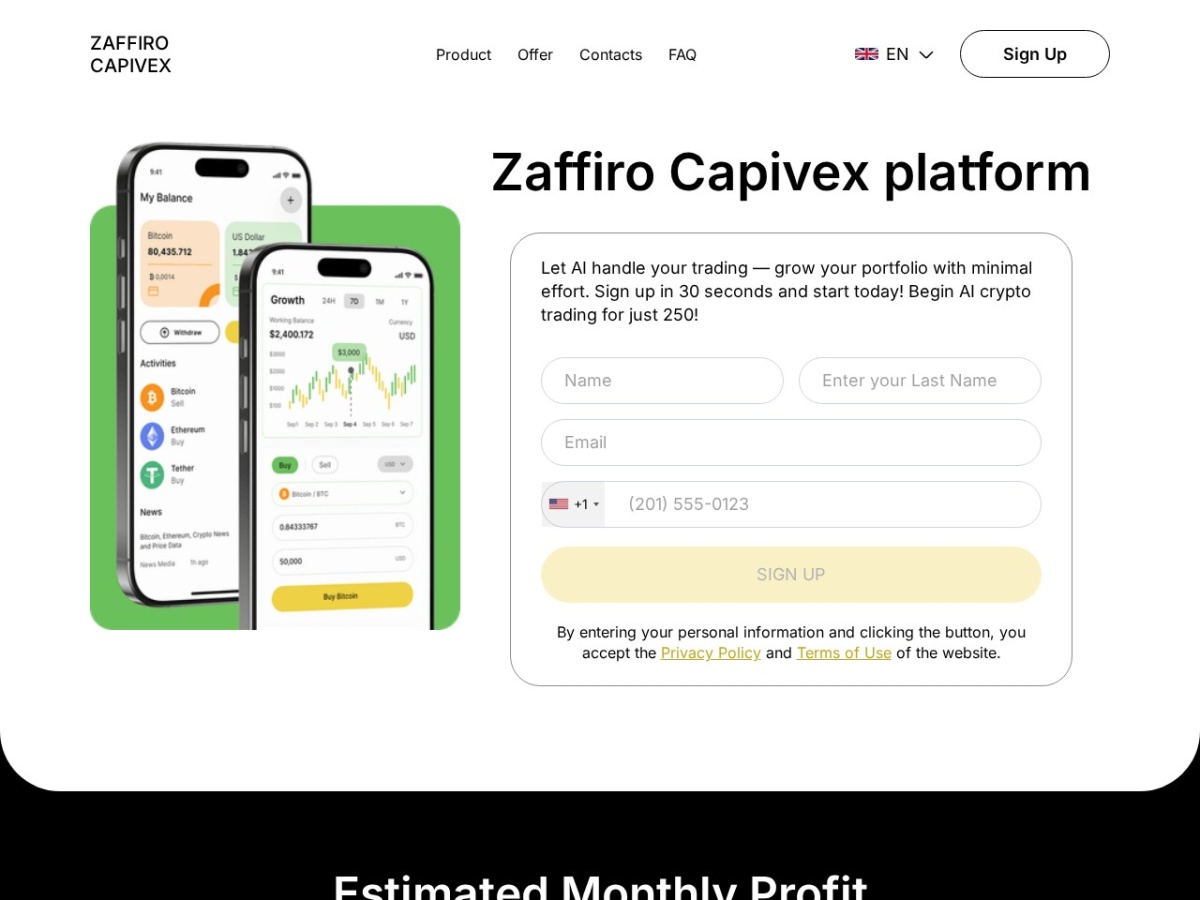
In the crowded and often murky world of AI-driven cryptocurrency trading platforms, Zaffiro Capivex has emerged as yet another contender promising automated profits with minimal effort. The pitch is familiar: deposit a few hundred dollars, let artificial intelligence do the heavy lifting, and watch your balance grow while you sleep. It's a narrative that has attracted millions of users to similar platforms—and left just as many wondering whether they've stumbled upon a genuine opportunity or another elaborate scam designed to separate hopeful investors from their money.
As an independent journalist who has spent years covering fintech, cryptocurrency, and the ever-evolving landscape of algorithmic trading, I've learned to approach such platforms with equal parts curiosity and skepticism. Zaffiro Capivex claims to serve over four million traders, boasts a reported success rate of eighty-five percent, and stores ninety-eight percent of user funds in cold storage—a security measure that, if true, would place it among the more responsible operators in the space. But numbers on a landing page are easy to fabricate, and slick marketing copy is cheaper than genuine infrastructure. The real question is whether Zaffiro Capivex delivers on its promises or simply offers another variation on a well-worn theme of overpromising and underdelivering.
The Promise: AI Trading Without the Learning Curve
Zaffiro Capivex positions itself as a solution to three problems that plague retail cryptocurrency traders: emotional decision-making, the time required to monitor markets around the clock, and the steep learning curve associated with technical analysis. The platform's core value proposition is straightforward—users can deposit as little as two hundred fifty dollars and allow the company's AI engine to scan over one hundred market signals per second, executing trades automatically based on data rather than gut feeling.
This is not a new concept. Algorithmic trading has existed in traditional finance for decades, and AI-driven crypto bots have proliferated over the past five years as machine learning technology became more accessible. What sets Zaffiro Capivex apart, at least in its marketing, is the emphasis on accessibility. The platform claims to require no prior trading experience, offers a thirty-second signup process, and provides both fully automated and manual trading modes for users who want more control.
The company also highlights its security infrastructure, asserting that ninety-eight percent of assets are held in cold storage—meaning offline, where they cannot be accessed remotely by hackers. It uses two-hundred-fifty-six-bit SSL encryption, two-factor authentication, and processes payments exclusively through verified providers without storing card details. On paper, these are all industry best practices. Whether they are implemented correctly and consistently is another matter.
The Red Flags: What Raises Suspicion
Before diving deeper into what Zaffiro Capivex offers, it's worth addressing the concerns that immediately stand out. First, the platform's website employs aggressive countdown timers and limited-time offers—classic high-pressure sales tactics designed to encourage impulsive deposits. The promise of beginning AI trading for just two hundred fifty dollars instead of one thousand, paired with a ticking clock, is a psychological nudge that legitimate platforms rarely need to resort to.
Second, the user testimonials are suspiciously vague and uniformly positive. Three Irish users—Róisín Kavanagh, Liam O'Connor, and Siobhan O'Brien—report returns of eighteen-point-four, twenty-four-point-one, and thirty-one-point-seven percent respectively. These testimonials lack verifiable details, timestamps, or third-party validation. In an industry plagued by fake reviews, this is not reassuring.
Third, the claim of four million traders is extraordinary and difficult to verify. For context, Coinbase, one of the largest and most established cryptocurrency exchanges in the world, reported approximately one hundred ten million verified users as of recent filings. If Zaffiro Capivex genuinely serves four million active traders, it would rank among the top platforms globally—yet it remains relatively unknown outside of targeted advertising campaigns.
Fourth, the platform's partnerships with major firms like Deloitte, CoinDesk, Nansen, and Decrypt are mentioned but not substantiated with specific details or verifiable documentation. Legitimate partnerships typically involve press releases, co-branded materials, or public acknowledgments from both parties. The absence of such evidence raises questions.
The Mechanics: How Zaffiro Capivex Claims to Work
According to the platform's own descriptions, Zaffiro Capivex operates as an AI-powered trading engine that monitors cryptocurrency markets continuously, analyzing over one hundred signals per second to identify trading opportunities. Users deposit funds—starting at two hundred fifty dollars—which the system then uses to execute trades automatically. The platform supports multiple funding methods, including credit cards, bank transfers, and PayPal, and claims to offer withdrawals at any time without restrictions or hidden fees.
The AI engine reportedly trades across a broad spectrum of assets, including equities, forex, commodities, precious metals, contracts for difference, and cryptocurrencies. This diversification is intended to spread risk and capture opportunities across different market conditions. The platform's interface is described as intuitive, suitable for both beginners and experienced traders, with educational resources and professional support available around the clock.
Users can switch between fully automated mode, where the AI handles everything, and manual mode, where they retain control over individual trades. This flexibility is a positive feature, assuming it functions as advertised. Real-time performance reporting is emphasized, with the platform asserting that every trade, signal, and balance update appears instantly on the user dashboard. Transparency, if genuine, is a critical factor in distinguishing legitimate platforms from scams.
The Security Claims: Are They Credible?
Security is perhaps the most critical consideration when evaluating any platform that holds user funds. Zaffiro Capivex makes several specific claims: two-hundred-fifty-six-bit SSL encryption, TLS one-point-three protocols, ninety-eight percent cold storage, verified payment processors, two-factor authentication, real-time account monitoring, and one-way encrypted password storage.
These measures, if implemented properly, represent industry best practices. Cold storage is particularly important in the cryptocurrency space, as it protects the majority of assets from online attacks. However, the fact that a platform advertises these features does not guarantee their correct implementation or ongoing maintenance. Security audits, third-party certifications, and transparent incident response protocols are what separate serious platforms from those that simply check boxes on a marketing checklist.
Notably absent from Zaffiro Capivex's materials are details about regulatory compliance, licensing, or third-party security audits. In jurisdictions with strict financial regulations, platforms that handle user funds are typically required to register with regulatory bodies, undergo regular audits, and maintain certain capital reserves. The lack of information about regulatory standing is a significant gap.
The Performance Claims: Can You Really Expect Returns?
Zaffiro Capivex advertises an eighty-five percent accuracy rate and showcases user testimonials reporting returns ranging from eighteen to thirty-two percent. The platform's FAQ section includes a disclaimer that results reported by individual users do not guarantee future performance and that trading involves risk—a legally prudent statement, but one that sits uncomfortably alongside aggressive marketing promising profits.
The truth is that cryptocurrency markets are notoriously volatile, and while algorithmic trading can offer advantages in terms of speed and emotionless execution, no AI can predict market movements with eighty-five percent accuracy over the long term. Even the most sophisticated hedge funds and institutional traders experience losses. The idea that a platform accessible to retail investors with no experience can consistently outperform the market is, at best, optimistic and, at worst, misleading.
Moreover, the platform's promotional materials include a calculator suggesting potential future balances based on user deposits, which projects steady growth over fifty days. Such calculators are inherently misleading because they imply predictability in an unpredictable market. No responsible trading platform should present hypothetical returns as if they were probable outcomes.
The User Experience: What Are Traders Actually Saying?
Beyond the curated testimonials on the Zaffiro Capivex website, independent user reviews are harder to find. The platform claims a four-point-nine rating based on over one thousand reviews, but the source of these ratings is not clearly identified. Trustpilot, Google Reviews, and other major review platforms do not currently display a significant volume of verified feedback for Zaffiro Capivex, which is unusual for a platform claiming millions of users.
This lack of widespread, verifiable user feedback is concerning. Legitimate platforms typically accumulate a substantial digital footprint over time, with users sharing their experiences—both positive and negative—across forums, social media, and review sites. The relative silence around Zaffiro Capivex suggests either a very new operation or one with a limited user base, despite the four-million-trader claim.
The Verdict: Scam or Legit?
So, is Zaffiro Capivex a scam or a legitimate trading platform? The answer, frustratingly, lies somewhere in the gray zone that characterizes much of the cryptocurrency industry. There is no smoking gun evidence that Zaffiro Capivex is a straightforward scam designed to steal user deposits outright. The platform appears to function, offers real trading capabilities, and processes deposits and withdrawals—at least according to its own claims and limited user reports.
However, the aggressive marketing tactics, unverifiable performance claims, lack of regulatory transparency, and absence of widespread independent verification raise serious red flags. The platform operates in a regulatory gray area, and the level of risk involved is higher than with established, licensed exchanges. The promise of consistent, high returns with minimal effort is almost always a warning sign, regardless of whether the underlying technology is real.
For investors considering Zaffiro Capivex, the key is to approach with extreme caution and a clear understanding of the risks. If you decide to invest, do so only with money you can afford to lose entirely. Start with the minimum deposit, test the platform's withdrawal process early, and never assume that past performance—real or claimed—will predict future results. The cryptocurrency market is unforgiving, and even the best AI cannot eliminate risk.
Ultimately, whether Zaffiro Capivex is a scam depends largely on how one defines the term. If a scam is a platform that makes exaggerated promises, employs high-pressure sales tactics, and operates with limited transparency, then Zaffiro Capivex exhibits many of those characteristics. If a scam is a platform that simply takes your money and disappears, the evidence for that is less clear. What is certain is that this platform, like so many others in the space, requires investors to take full responsibility for their decisions and to conduct thorough due diligence before committing funds.
The facts and data used in this article were provided by Zaffiro Capivex as part of their marketing and informational materials, which served as the factual basis for this independent analysis.