
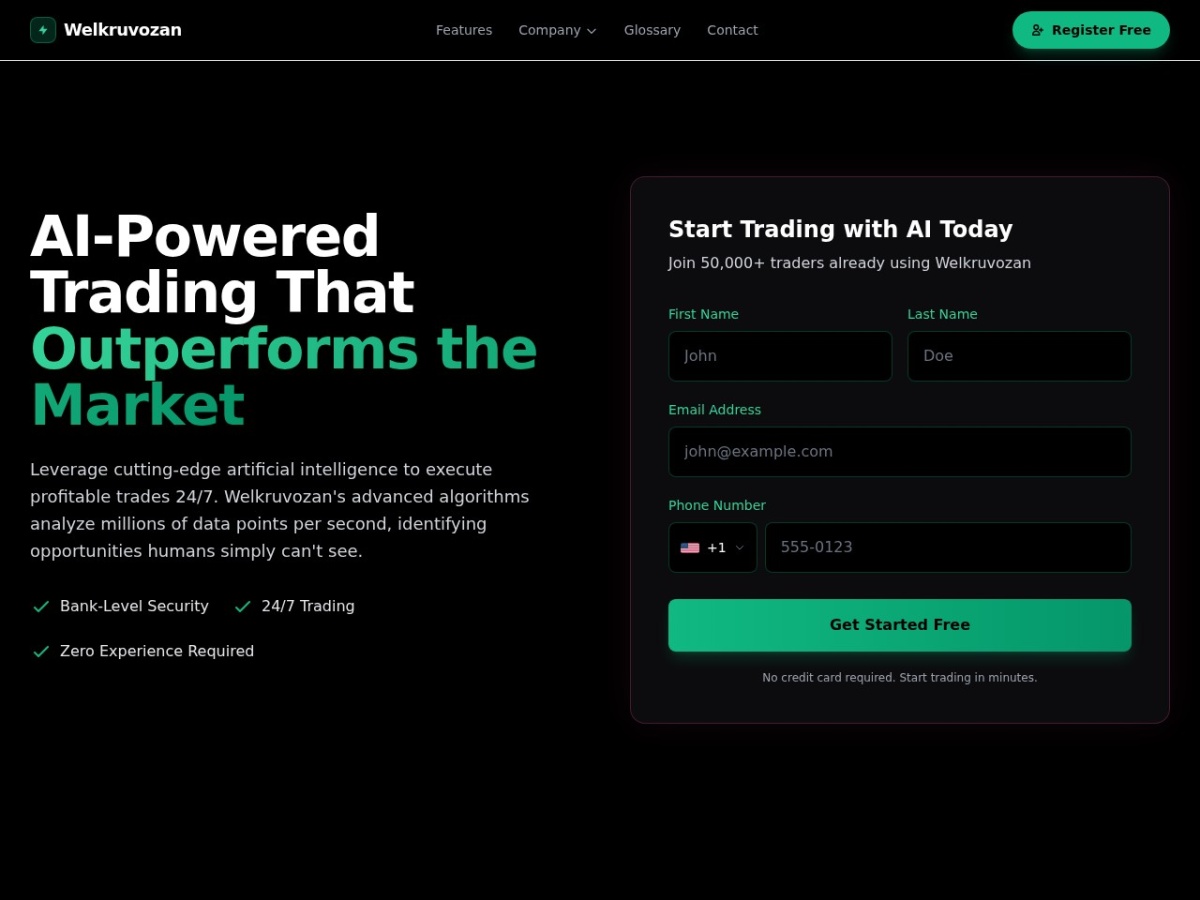
The online trading space is crowded with platforms promising effortless riches, most of which fail to deliver anything beyond slick marketing and empty wallets. When Welkruvozan appeared on my radar—claiming its AI bot generates an average of $564 daily per client, analyzes over ten million signals per second, and boasts a 94.3% prediction accuracy rate—I approached it with the same skepticism I bring to any project advertising triple-digit annual returns. The question isn't whether these numbers sound good; it's whether they're remotely sustainable, verifiable, or even plausible.
After reviewing the platform's materials, user testimonials, technical claims, and operational structure, I found myself in a peculiar position: Welkruvozan sits on the edge between an ambitious, potentially legitimate AI trading operation and a textbook setup for disappointment. This isn't a clear-cut case. There are elements that suggest genuine technological development and customer support infrastructure, yet the promises are so bold that they trip every alarm bell in the experienced investor's toolkit. What follows is an honest, granular breakdown of what Welkruvozan offers, what it claims to do, and where the cracks—or opportunities—might lie.
The Core Proposition: AI That Never Sleeps
Welkruvozan markets itself as an AI-powered trading engine capable of operating across forex, cryptocurrencies, stocks, and commodities around the clock. The platform claims its neural network monitors 200-plus trading pairs simultaneously, processes over three million data points per second, and executes decisions in just twelve milliseconds—faster than any human trader could blink, let alone analyze a chart.
In theory, this is precisely the kind of edge algorithmic trading is supposed to provide. High-frequency trading firms and institutional players have been doing something similar for years, profiting from speed and data processing capacity that retail traders simply can't match. The difference is that those operations cost millions to build and maintain. Welkruvozan is offering comparable firepower to anyone willing to deposit a minimum of $250, with zero prior trading experience required.
The platform's interface reportedly displays live AI market analysis, showing real-time decisions on pairs like Bitcoin, Ethereum, and Solana. Each trade is accompanied by metadata: pattern recognition results, risk assessments across dozens of indicators, stop-loss and take-profit targets, and a risk-reward ratio calculated in those same twelve milliseconds. If this infrastructure is real and functions as advertised, it would represent a significant democratization of tools previously reserved for hedge funds and proprietary trading desks.
But here's the tension: extraordinary claims require extraordinary evidence, and Welkruvozan provides testimonials, advertised win rates, and curated profit screenshots—not audited trading logs, third-party performance verification, or transparent disclosure of drawdowns and losing periods. That gap is where doubt creeps in.
The Numbers Game: 300–500% Annual Returns and a 91% Win Rate
Let's talk about the elephant in the room. Welkruvozan advertises that clients earn between 300% and 500% per year on average. Some users, according to the platform, double their capital within months. The claimed win rate hovers around ninety-one percent, and one testimonial from a self-described accountant mentions manually tracking trades in a spreadsheet to confirm that figure.
These are staggering numbers. For context, the S&P 500 has averaged roughly ten percent annual returns over the long term. Even the most successful hedge funds rarely sustain triple-digit returns year after year without catastrophic risk exposure. A ninety-one percent win rate is higher than what most professional algorithmic strategies achieve, especially across multiple asset classes and market conditions.
Does that make Welkruvozan a scam? Not necessarily. It makes it exceptional—and exception demands scrutiny. High win rates are achievable in certain market conditions, particularly in trending or low-volatility environments where momentum strategies thrive. The problem is sustainability. Markets cycle. Volatility spikes. Black swan events occur. Any system promising consistent performance across all conditions is either hedging in ways it doesn't disclose, taking on hidden leverage, or cherry-picking results from its best periods.
The calculator embedded on the site projects daily income of $564, which compounds to over $16,000 monthly if scaled linearly. That figure is based on unspecified assumptions about deposit size, leverage, and market conditions. Without seeing the underlying math or historical performance data across varying market phases—bull, bear, sideways, crisis—it's impossible to assess whether these projections are realistic, optimistic, or outright fictional.
Personal Curators and Five-Minute Support: A Differentiator or a Red Flag?
One feature Welkruvozan emphasizes heavily is the provision of a personal curator for every client. This isn't a chatbot or a FAQ page—it's described as a dedicated, experienced trader who guides users through strategy adjustments, answers questions around the clock, and monitors individual account performance. The platform claims a five-minute average response time and a ninety-eight percent customer satisfaction rate.
If true, this is a substantial operational commitment. Staffing a support team capable of responding to potentially tens of thousands of users within minutes, at any hour, costs real money. It suggests either a well-funded operation with serious infrastructure or a small user base being marketed as large to create the illusion of scale.
The value of a personal curator depends entirely on their expertise and the nature of the advice they provide. Are they helping users understand risk management, diversification, and realistic expectations? Or are they primarily onboarding agents designed to encourage larger deposits and prevent withdrawals? The distinction matters. In legitimate operations, support teams add genuine educational value. In dubious ones, they're retention tools dressed up as concierge service.
Welkruvozan's emphasis on this feature is either a sign of confidence in its customer experience or a calculated play to build trust and stickiness. Without direct access to the platform and its curators, it's difficult to say which.
User Testimonials: Authentic Voices or Scripted Theatre?
The platform showcases over twelve thousand verified reviews with an average rating of 4.9 out of 5. Individual testimonials report profits ranging from just under eight thousand dollars to over eighty-five thousand, with users describing everything from early retirement to replacing full-time salaries.
The testimonials are detailed, emotionally resonant, and geographically diverse—spanning Ohio, Germany, the UK, Florida, Canada, Australia, Spain, Texas, the Netherlands, Japan, Mexico, and Nigeria. They include first names, last initials, occupations, and time frames. Some mention specific profit figures; others describe skepticism overcome, support experiences, or life-changing outcomes.
Here's the problem: testimonials, even detailed ones, are not evidence. They can be real, curated, exaggerated, or entirely fabricated. The lack of verifiable user identities, account screenshots with timestamps, or third-party review aggregation makes it impossible to confirm authenticity. Even if some are genuine, selective presentation of only positive outcomes is standard practice in marketing and tells us nothing about the experience of users who lost money, failed to profit, or struggled to withdraw funds.
One testimonial from an accountant who claims to have tracked every trade manually and verified a ninety-one percent win rate is particularly interesting. If genuine, it's one of the few data points that approaches independent verification. But without access to that spreadsheet or the ability to cross-reference it with live trading data, it remains anecdotal.
Security, Regulation, and the Insurance Question
Welkruvozan claims to use military-grade encryption, multi-factor authentication, and cold storage wallets. It states that accounts are insured up to $500,000 and that the platform is "fully regulated by major financial authorities," passing independent security audits quarterly.
These are strong assurances—if they're true. The problem is that the materials provided don't specify which regulatory bodies oversee the platform, which jurisdiction it operates under, or which insurance provider backs the half-million-dollar coverage. Legitimate financial platforms typically disclose regulatory licenses prominently, naming the FCA, SEC, ASIC, or equivalent authorities. Welkruvozan's omission of these details is conspicuous.
Cold storage and encryption are table stakes for any platform handling user funds, not unique selling points. The real test of security is transparency: Are there public audit reports? Can users verify reserve balances? Is there a clear legal entity and registered address? Without these, even the most sophisticated technical security is a black box.
The insurance claim is particularly murky. If accounts are insured up to half a million dollars, that coverage would be underwritten by a third-party insurer with specific terms and conditions. The absence of details raises the question: Is this genuine insurance, a marketing exaggeration, or an internal reserve fund being mischaracterized?
Withdrawal Policies: The Ultimate Litmus Test
Welkruvozan promises withdrawals within twenty-four to forty-eight hours, with no lock-in periods, no penalties, and no minimum holding time. It claims thousands of users make regular weekly withdrawals.
If this is accurate, it's one of the strongest signals of legitimacy. Scam platforms typically make deposits easy and withdrawals impossible, using terms-of-service loopholes, verification delays, or outright refusal. A platform that processes withdrawals quickly and reliably, especially at scale, has a much higher likelihood of being a functioning business.
But again, we're relying on the platform's own claims. Independent verification would require testimonials from users who successfully withdrew funds, ideally with proof of transaction, and a track record over time showing consistent access to capital. Until such evidence surfaces, the withdrawal promise remains a promise.
The Risk You're Not Being Told About
Even if Welkruvozan's AI is as sophisticated as claimed, algorithmic trading is inherently risky. No system is immune to market shocks, liquidity crises, or unforeseen events. The 2010 Flash Crash, the 2020 COVID-19 market panic, and the 2022 crypto collapse all demonstrated how quickly automated systems can be overwhelmed.
Welkruvozan's marketing emphasizes gains but is conspicuously silent on drawdowns, maximum historical loss, volatility of returns, or risk management protocols during adverse conditions. A ninety-one percent win rate doesn't mean the nine percent of losing trades are small—if those losses are disproportionately large, the net result can still be catastrophic.
Any investor considering this platform should assume the possibility of total capital loss. The absence of detailed risk disclosure, historical performance transparency, and independent verification means you're operating on faith, not data.
So, Is Welkruvozan a Scam or Legit?
Here's my honest assessment: Welkruvozan exhibits characteristics of both a potentially legitimate high-risk trading platform and a sophisticated marketing operation designed to capitalize on the allure of passive income through AI. The technology claims are plausible—algorithmic trading at the millisecond level exists and is profitable for those who can execute it. The support infrastructure and user testimonials, if genuine, suggest operational substance. The withdrawal policy, if honored, would be a strong indicator of legitimacy.
But the red flags are impossible to ignore. The promised returns are extraordinary, bordering on unrealistic. The lack of transparent regulatory disclosure, third-party audits, and verified performance data leaves enormous gaps. The marketing language is polished and persuasive, precisely the kind used by platforms that prioritize customer acquisition over fiduciary responsibility.
Does that mean you should avoid it? Not necessarily—but it does mean you should proceed with extreme caution. If you're considering Welkruvozan, treat it as a high-risk speculative experiment, not a reliable income stream. Deposit only what you can afford to lose entirely. Test the withdrawal process early and often. Demand transparency from your personal curator. And above all, take personal responsibility for the decision. No platform, no matter how advanced its AI, can absolve you of the risks inherent in trading volatile assets.
Welkruvozan might be a groundbreaking tool that genuinely delivers on its promises. It might also be an elaborate mirage. The truth probably lies somewhere in between—a real platform with real technology, marketed with overblown promises and insufficient disclosure. Until independent verification emerges, skepticism is not only warranted; it's essential.
The data and claims discussed in this article were provided by Welkruvozan as source material for this independent review.