
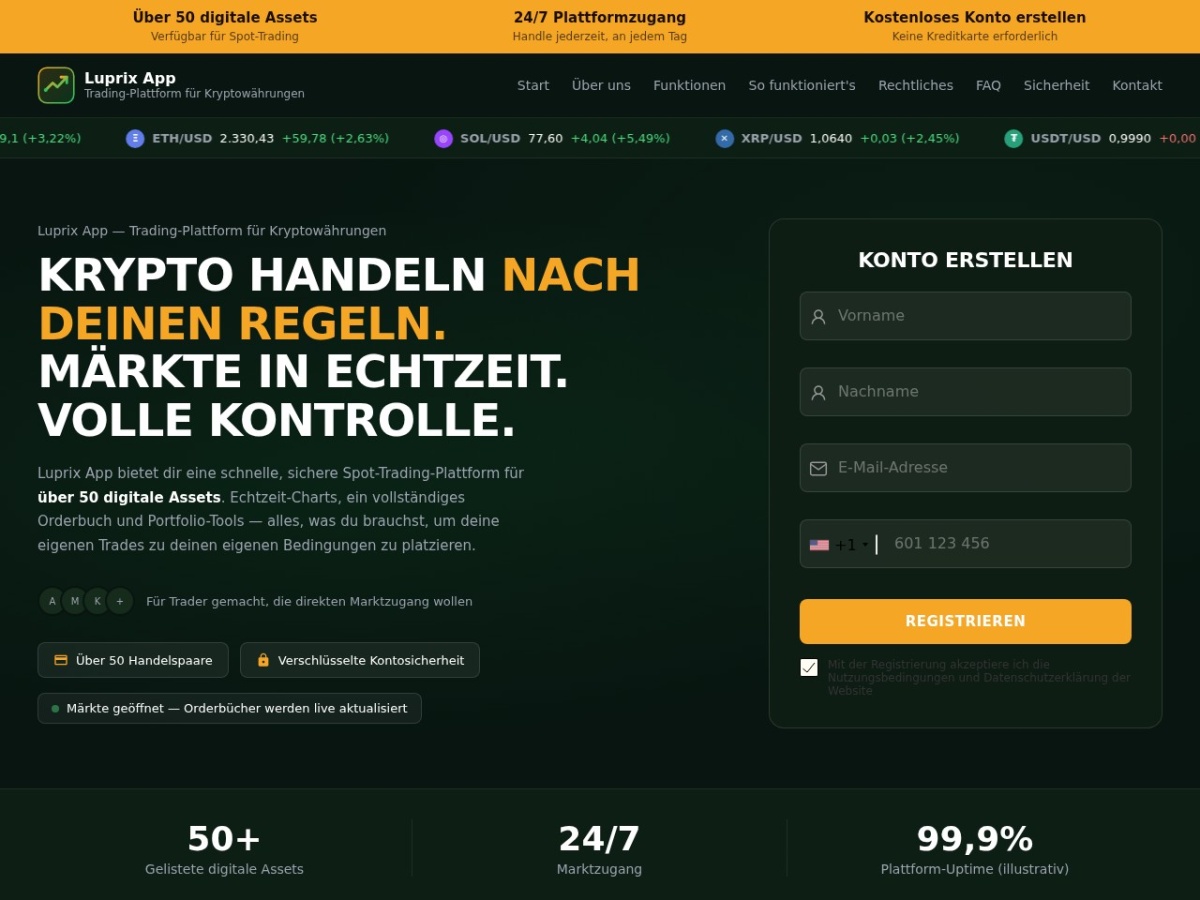
The rise of cryptocurrency trading platforms has created a landscape where distinguishing legitimate services from elaborate scams has become an essential skill for anyone considering digital asset investment. When a new platform emerges promising streamlined access to crypto markets, the first question any prudent investor should ask is: can this be trusted? Luprix App positions itself as a spot-trading platform offering access to over fifty digital assets with real-time market data and full user control. But in an industry plagued by exit scams, wash trading, and phantom exchanges, does Luprix App represent a genuine trading environment or another cautionary tale waiting to unfold?
The Red Flags and Green Lights: What the Platform Actually Shows
Any independent review must begin with the evidence at hand. Luprix App presents itself with several characteristics that warrant both scrutiny and cautious optimism. The platform claims to offer spot trading across more than fifty cryptocurrency pairs with continuous market access, encrypted account security, and what they describe as a security-first infrastructure featuring cold storage reserves and two-factor authentication.
On the surface, these are standard features for any legitimate exchange. The question becomes whether these claims are substantiated by actual functionality or merely marketing window-dressing. The platform's website demonstrates a functional trading interface with live order books, multiple order types including market, limit, and stop orders, and portfolio tracking tools. Unlike many scam operations that rely on fabricated screenshots and vague promises, Luprix App at least presents a coherent technical architecture.
However, several aspects deserve careful attention. The platform openly states that certain numbers displayed are "illustrative" and that the interface shown is a "demo template" not reflecting a genuine trading platform in some contexts. This transparency is actually somewhat refreshing compared to fraudulent operations that present everything as operational fact, but it also raises questions about the platform's current stage of development and whether users are trading on a fully mature infrastructure or something still being refined.
The Economic Model: How Luprix App Claims to Make Money
Understanding a platform's revenue model is crucial to assessing its legitimacy. Scam operations typically rely on user deposits that are never returned, while legitimate exchanges profit from transaction fees, withdrawal charges, and occasionally margin lending. Luprix App presents a maker-taker fee structure with indicative rates of approximately 0.10% for maker orders and 0.20% for taker orders, calculated on the order size.
This fee structure falls within the range of established exchanges, neither suspiciously low to suggest a loss-leader trap nor exploitatively high to indicate predatory pricing. The platform includes a fee calculator that demonstrates how costs scale with trade size, showing a degree of transparency about the economic relationship between user and platform. For a thousand-dollar order executed as a taker order, the estimated fee would be two dollars, leaving a net amount of nine hundred ninety-eight dollars.
The presence of a clear, comprehensible fee structure is generally a positive indicator. Scam platforms often obscure their fee arrangements or spring unexpected charges at withdrawal time. That said, the disclaimer that actual fees depend on account tier and order type at the time of trade introduces variables that could potentially be manipulated, though this caveat is standard across legitimate exchanges as well.
Security Architecture: Genuine Protection or Security Theatre?
Security claims are where scam platforms most frequently engage in deception, promising bank-grade encryption and military-level protection while operating on compromised infrastructure. Luprix App describes several security layers: encrypted data transmission and storage, cold storage for the majority of platform reserves with only operational balances maintained in hot wallets, two-factor authentication, biometric login options for mobile access, and withdrawal confirmation emails.
These measures represent industry best practices, but implementation quality determines their actual value. The platform explicitly warns users to be vigilant about phishing attempts and states that Luprix App will never proactively contact users requesting passwords, seed phrases, or immediate money transfers. This warning itself is a positive sign, as scam operations typically engage in exactly these behaviors through fake support channels.
The cold storage claim is particularly significant. Legitimate exchanges typically keep seventy to ninety-five percent of user funds in offline cold wallets, inaccessible to hackers targeting internet-connected systems. If Luprix App actually implements this architecture as described, it represents a substantial security commitment. However, verifying such claims from outside the organization remains challenging, and users must ultimately accept some degree of trust that these protocols are genuinely in place.
User Experience Design: Accessibility or Camouflage?
The platform's interface design philosophy merits examination. Luprix App emphasizes a "beginner-friendly interface" with an integrated glossary for trading terminology, guided tours for new accounts, and a cloud-based architecture requiring no software downloads or installations. The accessibility from any device without technical setup requirements lowers barriers to entry, which cuts both ways from a legitimacy standpoint.
Scam platforms often employ sophisticated user interfaces to create an illusion of professionalism, knowing that visual polish can substitute for substance in the minds of inexperienced investors. Conversely, genuinely legitimate platforms also invest heavily in user experience because customer acquisition in the competitive crypto exchange market depends heavily on interface quality and onboarding smoothness.
The four-step account creation process described by Luprix App follows conventional patterns: registration with email and password, identity verification through standard procedures, deposit and market exploration using live charts and order books, then autonomous order placement with withdrawal capability at user discretion. The inclusion of identity verification requirements is actually reassuring, as truly fraudulent operations often skip KYC procedures to avoid regulatory scrutiny and maintain operational anonymity.
The Control Question: Who Executes the Trades?
A critical distinction separates legitimate trading platforms from investment scams disguised as exchanges. Luprix App explicitly states that it does not trade on behalf of users, promises no returns, and provides only the infrastructure for users to implement their own strategies. This represents a fundamentally different model from fraudulent "investment platforms" that promise guaranteed returns, claim to have expert traders generating profits on user deposits, or describe proprietary trading algorithms.
The platform's disclaimer that cryptocurrency trading involves risks including potential loss of invested capital, that users should only trade amounts they can afford to lose, and that nothing on the site constitutes financial advice represents legally prudent language that scam operations typically avoid. Fraudulent platforms want users believing in guaranteed profits, while legitimate exchanges emphasize risk and personal responsibility.
This philosophical approach aligns with how genuine exchanges operate: they provide market access and execution infrastructure but remain neutral regarding trading outcomes. Users bear full responsibility for their trading decisions, market analysis, and risk management. The platform facilitates transactions but does not participate in them as a counterparty or promise any particular results.
The Transparency Test: What Information is Actually Provided?
Evaluating a platform's legitimacy often comes down to what information it volunteers versus what it conceals. Luprix App's website includes several transparency elements worth noting: clear warnings that displayed performance metrics are illustrative examples rather than guaranteed outcomes, explicit statements that certain interface elements shown are demo templates, repeated disclaimers about trading risks, detailed descriptions of security measures with acknowledgment that these are "described here for demonstration purposes," and straightforward answers to frequently asked questions that avoid overpromising.
This level of disclosure creates a complex picture. On one hand, the repeated qualifications that certain elements are illustrative or demonstrative could suggest the platform is not yet fully operational or that the actual trading environment differs substantially from what is presented. On the other hand, this transparency about the demonstrative nature of certain content actually exceeds what most scam operations provide, as fraudulent platforms typically present everything as fully operational and proven.
The frequently asked questions section addresses critical concerns directly: confirming that no returns are guaranteed, stating that the platform does not trade on users' behalf, describing security measures while acknowledging they are standard practices, and providing clear answers about fees, withdrawals, and data privacy. A scam platform would typically dodge these questions or provide vague, reassuring answers rather than direct statements about risk and responsibility.
Market Data and Execution: Real Trading or Simulated Activity?
The platform claims to offer real-time market data with live price feeds, depth charts, historical data integration, and order execution with an average latency under fifty milliseconds. These technical specifications, if accurate, would indicate genuine market connectivity and professional-grade infrastructure. However, verifying such claims requires actual platform usage and independent testing.
The displayed price tickers for Bitcoin, Ethereum, Solana, XRP, USDT, BNB, and Cardano show specific values with percentage changes: Bitcoin at 96,382 dollars with a 3.22% increase, Ethereum at 2,330.43 dollars with a 2.63% gain, and so forth. These figures presumably reflect snapshot market data, though without timestamps their verification becomes difficult. Legitimate exchanges display constantly updating tickers that can be compared against established price indices; static or fabricated prices that do not correspond to broader market movements indicate fraudulent operations.
The order book functionality described, showing bid and ask prices with depth visualization, represents essential infrastructure for actual trading rather than simulated activity. Fake exchanges often display order books that appear active but do not reflect real market depth or fill orders at the displayed prices. The true test of legitimacy comes when users attempt to execute trades: do orders fill at advertised prices, does slippage correspond to actual market conditions, and can users successfully withdraw both deposits and any trading gains?
The Withdrawal Reality Check: The Ultimate Legitimacy Test
No aspect of platform legitimacy matters more than withdrawal functionality. The most elaborate scam can maintain a convincing facade right up until users attempt to extract their funds, at which point the fraudulent nature becomes unmistakably clear through blocked withdrawals, invented compliance requirements, or sudden technical difficulties.
Luprix App states that users can withdraw available balances at any time to their linked payment methods, that withdrawal requests are reviewed and processed within a specified timeframe then sent to the registered wallet address or payment method, and that withdrawal actions require authentication confirmation. These descriptions align with legitimate exchange procedures, but only actual user experience can confirm whether withdrawals process as described or encounter the obstacles characteristic of scam operations.
The platform's emphasis that users maintain control over their funds, can place and manage orders continuously, and can withdraw at their discretion represents the correct operational model. Fraudulent platforms typically impose withdrawal restrictions such as minimum account periods, required trading volumes before first withdrawal, or fabricated tax payments to unlock funds. If Luprix App genuinely allows unrestricted withdrawals following standard authentication procedures, this represents strong evidence of legitimacy.
The Regulatory Question: Compliance or Concealment?
Legitimate cryptocurrency exchanges increasingly operate within regulatory frameworks, obtaining licenses where required and implementing compliance measures including know-your-customer identity verification and anti-money-laundering procedures. Luprix App's description of "standard identity verification" before deposits suggests some level of regulatory awareness and compliance infrastructure.
However, the platform does not prominently display regulatory licenses, registration jurisdictions, or specific compliance certifications in the material provided. This absence could indicate several scenarios: the platform operates in a jurisdiction with minimal cryptocurrency regulation, it has not yet obtained relevant licenses, or it operates in a legal gray area common to many crypto services. While concerning, this alone does not confirm fraudulent intent, as many legitimate smaller exchanges also lack prominent regulatory credentials, particularly newer platforms still establishing their operational footprint.
The inclusion of a privacy policy reference and statements about data protection suggest at least consideration of regulatory requirements around user information. Scam platforms typically pay minimal attention to data privacy frameworks, having no intention of long-term operation that would necessitate regulatory compliance.
Comparative Analysis: How Luprix App Measures Against Known Patterns
Evaluating Luprix App against established patterns of both legitimate exchanges and known scams reveals a mixed profile that defies simple categorization. Characteristics aligning with legitimate operations include transparent fee structures with calculable costs, explicit risk disclaimers and rejection of guaranteed returns, detailed security measure descriptions with user warnings about phishing, identity verification requirements before deposit access, clear statements that the platform does not trade on users' behalf, and functional descriptions of trading infrastructure including order types and portfolio tools.
Characteristics raising caution include extensive use of qualifiers stating that certain elements are illustrative or demonstrative, limited verifiable operational history or user testimonials, absence of prominent regulatory credentials or licensing information, relatively new market presence without established track record, and insufficient independent verification sources beyond platform-provided information.
This profile suggests a platform that may be genuinely attempting to establish a legitimate trading service but has not yet accumulated the operational history, regulatory credentials, and independent verification that would provide stronger confidence. It occupies an ambiguous middle ground between obvious scams and established trustworthy exchanges.
The Investor's Dilemma: Calculated Risk or Reckless Gamble?
For potential users considering Luprix App, the decision framework must acknowledge uncertainty while weighing available evidence. The platform presents more positively than blatant scam operations that promise guaranteed returns, lack coherent technical infrastructure, or operate with obvious regulatory evasion. However, it also lacks the verified operational history, regulatory transparency, and independent validation that characterize established legitimate exchanges.
The prudent approach for any investor considering this platform involves several protective measures: starting with minimal deposits to test withdrawal functionality before committing substantial funds, enabling all available security features including two-factor authentication and withdrawal confirmations, maintaining records of all transactions and communications with the platform, researching independent user experiences beyond platform-provided testimonials, and comparing actual trading execution against established exchanges to verify genuine market connectivity.
Most importantly, potential users must recognize that even if Luprix App proves to be a legitimate trading platform rather than an outright scam, cryptocurrency trading itself carries substantial risk of capital loss. The platform's own disclaimers emphasize that trading involves risk including potential loss of invested capital and that users should only trade amounts they can afford to lose. These warnings deserve serious consideration regardless of platform legitimacy.
The Verdict: Cautious Optimism with Eyes Wide Open
After examining available evidence, Luprix App appears more likely to represent a genuine if unproven trading platform rather than an elaborate scam, but this assessment comes with substantial caveats and cannot constitute a definitive determination of trustworthiness. The platform demonstrates several characteristics of legitimate operations including transparent fee disclosure, appropriate risk warnings, described security infrastructure, and operational models that align with genuine exchanges rather than fraudulent investment schemes.
However, the extensive use of illustrative disclaimers, limited verifiable operational history, and absence of regulatory credentials prevent a confident endorsement. The platform occupies that challenging middle ground where it might develop into a reliable trading service or might reveal significant problems only when substantial user funds accumulate. Early adopters would essentially be participating in an extended operational test rather than engaging with a proven, validated platform.
For investors willing to accept elevated risk in exchange for potential early access to a developing platform, Luprix App might represent a reasonable calculated risk provided they follow strict protective measures, begin with minimal deposits, verify withdrawal functionality immediately, and never commit funds beyond what they can afford to lose completely. For risk-averse investors or those seeking maximum security for substantial cryptocurrency holdings, established exchanges with verified operational histories and clear regulatory standing remain the more prudent choice.
The fundamental reality is that each investor must ultimately accept personal responsibility for due diligence and risk assessment. The cryptocurrency space continues to evolve with new platforms regularly emerging, some legitimate and some fraudulent. No external review can substitute for individual research, careful evaluation, and prudent risk management. Luprix App presents sufficient legitimacy indicators to warrant cautious consideration, but insufficient verification to justify confident trust or substantial capital commitment without personal testing and validation.
Whether Luprix App ultimately proves to be a reliable trading platform or a disappointment remains to be determined through actual operational performance over time. The evidence currently available suggests it deserves neither wholesale dismissal as an obvious scam nor enthusiastic endorsement as a proven legitimate service, but rather careful, skeptical engagement with appropriate protective measures from anyone choosing to explore its capabilities.
---
The facts and data for this article were provided by Luprix App. Additional information about their platform and services can be found at https://luprix.app/