
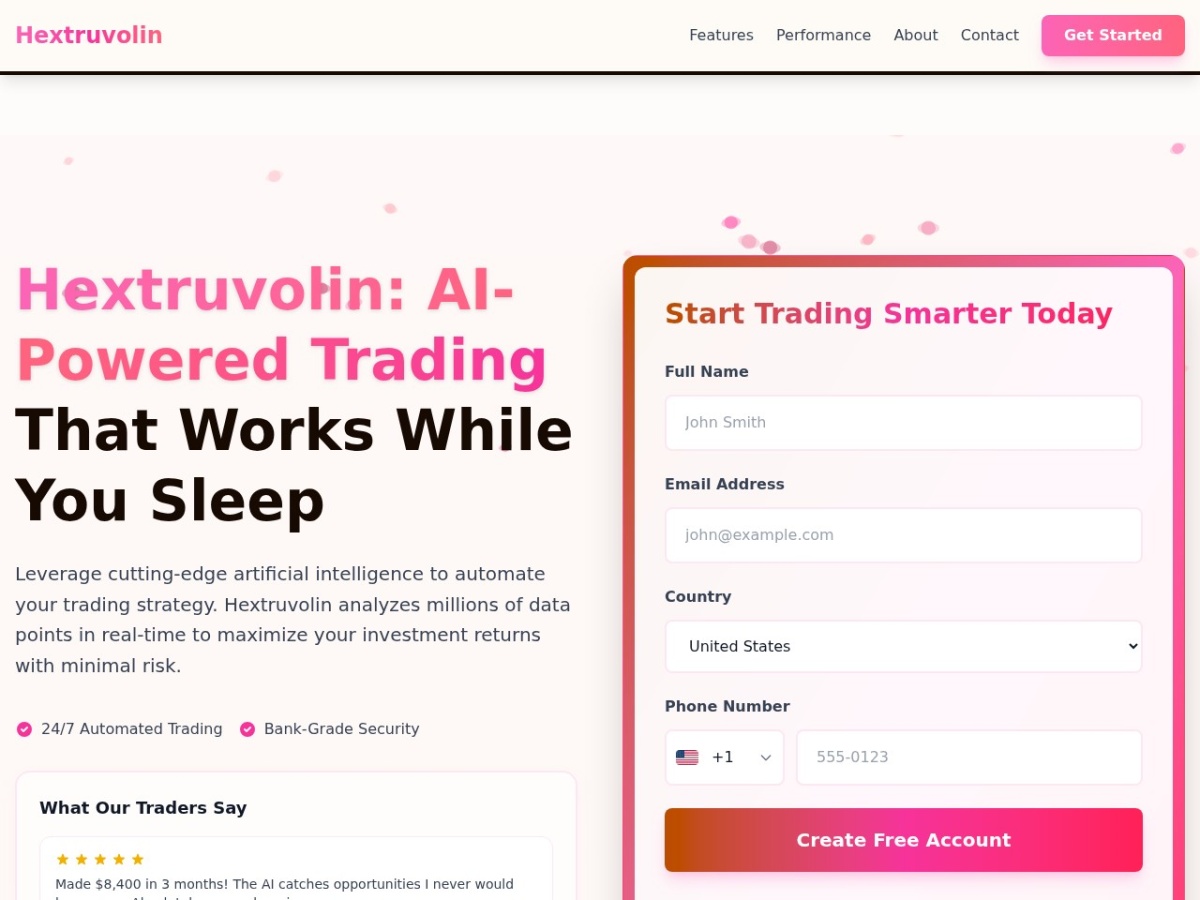
The world of automated trading platforms has exploded in recent years, and with it, a flood of promises that sound too good to be true. Some deliver; others disappear overnight with users' funds. So when Hextruvolin started appearing in my inbox with testimonials boasting four-figure profits in weeks and AI-powered precision trading, I decided to take a closer look. Is this another clever pump-and-dump scheme preying on inexperienced investors, or does it represent a legitimate—if risky—opportunity in the volatile crypto market?
The Core Proposition: AI That Never Sleeps
Hextruvolin positions itself as an AI-powered trading platform that operates around the clock, analyzing market data and executing trades automatically on behalf of its users. According to the company, their proprietary deep-learning algorithms process over 200 million market signals per minute across more than forty global exchanges. The platform claims a documented accuracy rate of 94 percent on executed trades, a figure that would be exceptional in any trading environment, let alone the notoriously unpredictable cryptocurrency market.
The appeal is obvious: you deposit funds, set your risk preferences, and let the machine do the heavy lifting while you focus on your day job or, ideally, sleep. The minimum deposit sits at $250, a relatively modest entry point compared to traditional wealth management services or some other crypto platforms that demand thousands upfront. The company promises returns in the range of 400 to 500 percent for users, with some testimonials citing even higher numbers over short timeframes.
On paper, this sounds like the holy grail of passive income. In practice, the reality is almost certainly more nuanced, and investors need to understand what they're getting into.
Red Flags and Why They Matter
Let's address the elephant in the room: the returns advertised by Hextruvolin are astronomically high. The platform's marketing materials mention 400 to 500 percent returns and cite testimonials of users turning a few hundred dollars into thousands within days or weeks. One example provided shows a hypothetical $250 investment growing to over $3,600 in just three days, and nearly $188,000 after three months. If sustained, those kinds of returns would make Hextruvolin the most profitable investment vehicle in human history, outpacing every hedge fund, venture capital firm, and traditional market index by orders of magnitude.
This is where alarm bells should start ringing for any seasoned investor. No legitimate financial service can guarantee those kinds of returns without exposing users to catastrophic risk. Markets don't work that way. Even the most sophisticated algorithmic trading systems operated by institutions like Renaissance Technologies or Two Sigma—firms with billions in assets and teams of PhD mathematicians—don't consistently produce returns anywhere near that level.
The testimonials themselves raise further questions. They're presented with first initials and last names, locations, and specific profit figures, but there's no way to independently verify these claims. In an era where fake reviews are a cottage industry and platforms routinely fabricate social proof, the absence of verifiable third-party validation is notable. The claim that the platform is "featured in Financial Times" and has been reviewed by Trustpilot with a 4.83 rating based on thousands of verified reviews could lend credibility—if those claims can be substantiated. But without direct links to those reviews or media mentions, it's impossible to confirm.
Then there's the urgency. The site employs classic scarcity tactics: "Only 19 spots left!" and a countdown timer warning that an offer is about to expire. This is a textbook marketing technique designed to bypass rational decision-making and push users toward impulsive action. Legitimate investment platforms don't operate with artificial scarcity or pressure tactics. They want informed, confident clients, not panicked ones.
The Technology: Plausible or Fantasy?
Hextruvolin's description of its technology is a mix of impressive-sounding jargon and vague assurances. The platform claims to use "proprietary deep-learning algorithms" and process millions of data points in real time. In theory, this is plausible. High-frequency trading firms and quantitative hedge funds do employ machine learning models to identify patterns and execute trades faster than any human could.
But here's the catch: building and maintaining such systems requires enormous capital investment, access to expensive data feeds, low-latency infrastructure, and teams of specialists. It's unclear how a platform that accepts $250 minimum deposits and offers such generous profit-sharing could sustain that kind of operation. Established quant funds charge hefty management fees and performance cuts precisely because the technology and talent are expensive.
Moreover, the claim of a 94.7 percent win rate is extraordinary. Even the best algorithmic traders experience losing trades; the key is that winners outweigh losers over time. A win rate that high, sustained across thousands of trades and market conditions, would be statistically anomalous. It's not impossible, but it demands a higher standard of proof than a marketing claim on a website.
If the AI is genuinely that effective, one has to ask: why would the operators share it with retail investors for a few hundred dollars? They could license it to institutional clients for millions or trade with their own capital and keep all the profits. The altruistic explanation—that they want to democratize access to cutting-edge trading tech—is heartwarming but not particularly convincing from a business perspective.
Regulatory Status and Security Guarantees
Hextruvolin claims to be "fully licensed," "certified and regulated," with "internationally recognized certifications and full regulatory compliance." These are important assertions, but they're also meaningless without specifics. Which regulators? Which jurisdictions? Which certifications?
Legitimate financial platforms are transparent about their regulatory status. They'll tell you they're registered with the Financial Conduct Authority in the UK, or the Securities and Exchange Commission in the US, or equivalent bodies in other countries. They'll provide registration numbers and links to official databases where you can verify their claims. Hextruvolin's website, as described in the material I reviewed, does not provide this level of detail.
The platform also promises "bank-grade security," "military-grade encryption," and insurance coverage for user funds. Again, these are reassuring words, but they lack substance without specifics. What insurance company underwrites the coverage? What are the terms? How much is covered per user? In the event of a hack, a bankruptcy, or a regulatory shutdown, how protected are investors really?
The promise of instant withdrawals within 24 to 48 hours is a positive sign. Scam platforms often make withdrawal difficult or impossible, locking users into their funds until the scheme collapses. If Hextruvolin does, in fact, process withdrawals quickly and reliably, that would suggest at least some degree of operational legitimacy. But again, this is something that can only be verified by actual users with real money at stake.
User Testimonials: Trust or Theater?
The testimonials featured on the site are glowing. Michael K. claims to have made $8,400 in three months. Sarah L. turned $500 into $2,100. David T. reports a 28 percent return over the year. Emma G. boasts over $15,800 in profit over ten months. These stories are compelling, and they span a range of returns—from the plausible (28 percent annually) to the extraordinary (multi-thousand-percent gains in weeks).
The variety actually lends a certain credibility. If every testimonial claimed instant riches, it would be easier to dismiss them all as fabrications. The fact that some users report modest, realistic gains suggests at least an attempt to present a balanced picture.
But without independent verification, these testimonials must be taken with a large grain of salt. Were these real users, or were they stock photos paired with invented stories? Did they actually withdraw their profits, or are those numbers just unrealized gains on a dashboard that may or may not reflect true account value?
One thing worth noting: if even half of these testimonials are genuine, it suggests that Hextruvolin has at least some operational infrastructure and a user base willing to publicly endorse it. That's a step above outright Ponzi schemes that collapse before anyone can withdraw a dime. But it's not proof of sustainability or legitimacy in the long term.
The Business Model: Where's the Catch?
Understanding how Hextruvolin makes money is critical to assessing its legitimacy. Typically, trading platforms generate revenue in a few ways: transaction fees, spreads on trades, management fees, or performance fees. Hextruvolin's materials mention "no hidden fees," which is encouraging, but they don't explicitly detail how the company is compensated.
If the platform is genuinely profitable and its AI consistently beats the market, the operators could simply trade with their own capital and keep all the gains. The fact that they're inviting retail investors to participate suggests either altruism (unlikely in finance) or a business model that relies on user deposits—either to generate trading volume, to earn spreads or commissions from partner exchanges, or, in the worst case, to fund withdrawals for earlier users in a Ponzi-like structure.
Without transparency about the revenue model, it's difficult to assess the platform's sustainability. Legitimate trading platforms are upfront about their fee structures. They'll tell you they charge 0.25 percent per trade, or they take 20 percent of profits above a certain threshold, or they earn rebates from exchanges. The absence of this information is another yellow flag.
Who Should Consider Hextruvolin—and Who Shouldn't
If you're looking for a guaranteed path to wealth with zero risk, Hextruvolin is not it. No investment is. Anyone who tells you otherwise is either lying or delusional.
That said, if you're comfortable with high-risk, speculative investments and you have money you can genuinely afford to lose, Hextruvolin might be worth exploring—but only with extreme caution. Treat your initial deposit as a test. Start with the minimum $250, monitor the platform's behavior closely, and attempt to withdraw profits as soon as possible. If withdrawals process smoothly and the platform behaves transparently, you can decide whether to increase your stake.
This is not the place for your retirement savings, your emergency fund, or money earmarked for your mortgage or your child's education. Crypto trading, even with sophisticated algorithms, is inherently volatile and risky. Automated systems can and do fail. Markets can turn on a dime. Even the best AI can't predict black swan events or sudden regulatory crackdowns.
If you have no experience with investing and you're drawn to Hextruvolin because of the promise of easy money, proceed with extreme caution. The platform's marketing is designed to appeal to people who feel left behind by traditional finance or who are desperate for a financial breakthrough. That desperation can cloud judgment.
Final Verdict: Scam or Legit?
So, is Hextruvolin a scam or a legitimate trading platform?
Honestly, based on the available information, it sits in an uncomfortable gray zone. There are enough red flags—unrealistic return promises, lack of regulatory transparency, high-pressure marketing tactics, unverifiable testimonials—that I would not recommend anyone invest money they can't afford to lose. The platform's claims are extraordinary, and extraordinary claims require extraordinary evidence, which Hextruvolin has not provided.
At the same time, the platform doesn't exhibit all the hallmarks of an outright scam. It offers a relatively low barrier to entry, promises fast withdrawals, and presents a coherent (if optimistic) technology narrative. If the AI does exist and does perform even a fraction as well as advertised, users could see genuine returns. But those returns are likely to be far more modest than the marketing suggests, and the risks are real.
My recommendation: approach Hextruvolin as a high-risk, speculative experiment, not a reliable investment strategy. If you choose to engage with the platform, do so with your eyes open, your expectations managed, and your capital protected. Diversify your investments, never put all your eggs in one basket, and remember that in finance, if something sounds too good to be true, it usually is.
Ultimately, every investor must take full responsibility for their own decisions. Platforms like Hextruvolin can be tempting, especially when traditional markets feel rigged or inaccessible. But temptation is not the same as opportunity, and hope is not a strategy.
Do your own research. Ask hard questions. Demand transparency. And above all, never invest money you can't afford to lose.
---
Source Note: The facts, figures, and details presented in this article were provided by Hextruvolin. For more information, you can visit their official website at https://hextruvolin.pro/.