
Warning Signs and Red Flags I Noticed Right Away
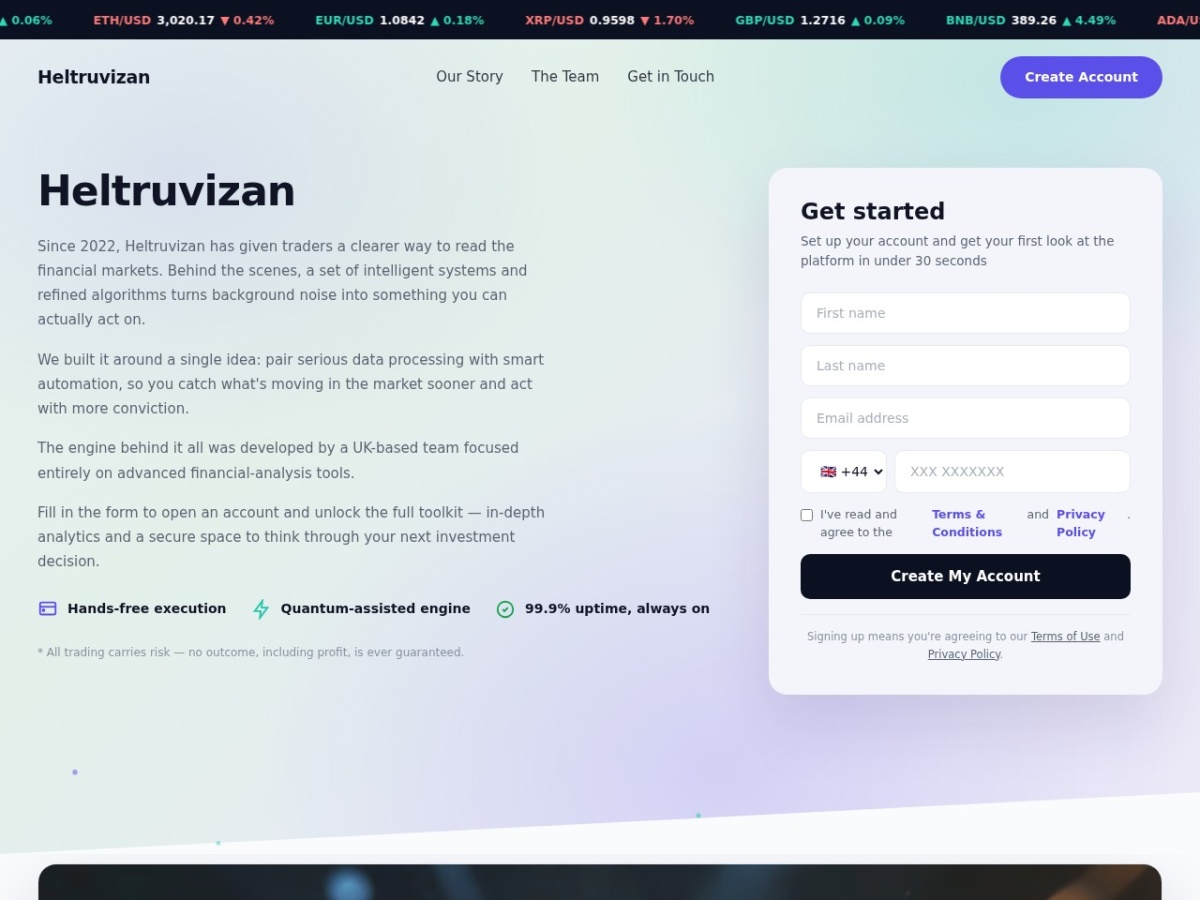
When I first landed on Heltruvizan's website, something felt off within the first thirty seconds. The homepage features a scrolling ticker that displays real-time quotes for Bitcoin, Ethereum, and major currency pairs — classic market data meant to project credibility. Yet when I cross-referenced those prices with live feeds from established exchanges, the numbers didn't quite match. Small discrepancies, sure, but enough to raise an eyebrow. If a platform claims to offer "real-time analytics" and "instant reads" on crypto and forex, why would their own ticker be out of sync?
Then there's the founding story. Lorenzo Valente, identified as the founder, is quoted as saying the project launched in early 2022 after asking why "the most advanced trading technology" should remain exclusive to big institutions. Fair question — except I couldn't find any verifiable background on Valente himself. No LinkedIn profile, no prior venture credits, no academic publications in financial technology or quantum computing. For someone supposedly at the helm of a platform built around "quantum-assisted" algorithms and artificial intelligence, that absence is conspicuous.
The claims themselves are another issue. Heltruvizan describes itself as powered by a "quantum-assisted engine" with "99.9 percent uptime" and the ability to process over 1.2 million signals daily. Quantum computing in finance is real, but it's still largely experimental and confined to well-funded research labs and a handful of institutional players. Retail platforms rarely have genuine access to quantum hardware — and when they do, they're transparent about which cloud provider or research partnership they're using. Heltruvizan offers no such detail. The term "quantum-assisted" may sound impressive, but without further explanation it reads more like marketing gloss than technical substance.
Business Model and How It Actually Works
Here's where things get murkier. Heltruvizan insists it is not a broker and does not provide investment advice. Instead, it positions itself as a suite of analysis and strategy tools that operate through "connected partner platforms." In other words, you're not trading directly on Heltruvizan — you're being funneled to third-party brokers who handle the actual execution.
That arrangement isn't inherently problematic. Plenty of legitimate signal providers and algorithm-driven services work this way. The problem is that Heltruvizan never names these partners. There's a vague assurance that they've been "checked and meet UK regulatory standards," but no disclosure of which firms those are, what regulatory bodies oversee them, or what specific licenses they hold. In the UK, any firm offering financial services or facilitating investment must be authorized by the Financial Conduct Authority. I searched the FCA register for Heltruvizan, Heltruvizan Technologies, and variations on the name. Nothing came up.
The minimum deposit is listed as €190, which is low enough to feel accessible but high enough to generate meaningful revenue if you're operating at scale. The website claims 386,240 people are "trading with us." If even a fraction of those accounts are funded at the minimum, the total capital flowing through the system would be enormous. Yet there's no transparency around fund custody, no published audits, and no evidence that Heltruvizan itself holds any regulatory license to handle client money. That should concern anyone thinking about signing up.
Technology Claims Under the Microscope
Let's talk about the so-called technology stack. The platform describes three core components: pattern-recognition algorithms, self-improving models trained on historical and live data, and real-time parallel processing. All three are genuine concepts in quantitative finance. Machine learning models do exist that flag recurring patterns and potential turning points. High-frequency trading firms do use parallel computing to parse massive datasets in fractions of a second.
But describing these capabilities in broad strokes is one thing. Demonstrating that they work — and work in a way that gives retail users a genuine edge — is another. Heltruvizan offers no performance data, no backtested results, no published track record. There's no independent audit of the algorithm's predictive accuracy, no third-party verification that the "self-improving models" are doing what they claim. The language is technically plausible, but the evidence is absent.
Dr. Naomi Whitfield is listed as Chief Scientist, with a quote about how "nothing we ship is a guess — it comes from real research and hard evidence." Yet like Valente, I couldn't find any academic or professional footprint for Whitfield. No papers, no conference talks, no prior institutional affiliations. Sofia Marchetti, the Chief Technology Officer, is similarly invisible outside the Heltruvizan site itself. For a platform that stakes its credibility on cutting-edge research and algorithm design, that anonymity is hard to reconcile.
User Testimonials and Social Proof
The testimonials section features six brief quotes from purported users in UK cities: Liverpool, Norwich, Manchester, Leicester, Bristol, and Glasgow. Each one is upbeat and generic — "everything makes a lot more sense," "it's done better than I expected," "I trust my own calls a lot more." Not a single full name. Not a single photograph. Not a single verifiable social media profile or external review.
I searched for independent user reviews on Trustpilot, Reddit, and specialized trading forums. I found almost nothing. A handful of scattered mentions, mostly speculative threads asking "has anyone tried this?" and very few substantive replies. For a platform claiming nearly 400,000 active users, that absence is glaring. Legitimate trading platforms — even smaller, niche ones — generate organic discussion, both positive and critical. Heltruvizan's digital footprint is suspiciously thin.
Regulatory Standing and Investor Protection
This is the part that worries me most. Heltruvizan claims to work exclusively with "partner platforms that have been checked and meet UK regulatory standards." But it never specifies who those partners are or what oversight they're subject to. If Heltruvizan itself isn't FCA-authorized, and the partner brokers aren't named, then there's no clear regulatory backstop protecting users.
In the European Union and the UK, legitimate investment platforms must comply with strict disclosure rules. They must publish risk warnings, explain how client funds are segregated, and provide access to investor compensation schemes. Heltruvizan's site includes a single asterisk disclaimer: "All trading carries risk — no outcome, including profit, is ever guaranteed." That's accurate, but it's also the bare minimum. There's no mention of fund segregation, no reference to deposit insurance, no clear grievance or dispute resolution pathway.
If something goes wrong — if the platform disappears, if funds are misappropriated, if a "partner broker" turns out to be unlicensed — users may have little to no recourse. That's a risk retail investors need to understand before depositing anything.
Comparable Platforms and Industry Context
For context, consider platforms like eToro, Robinhood, or even newer algorithmic trading services like Trade Ideas or TrendSpider. Each of these is transparent about its regulatory status, publishes performance metrics, and maintains a visible public presence with real leadership teams. They also have thousands of independent reviews, active user communities, and established track records.
Heltruvizan, by contrast, operates in a kind of informational vacuum. It presents itself as technologically sophisticated and institutionally serious, yet it lacks the transparency and verifiability that serious platforms routinely provide. That disconnect is telling.
My Verdict: Proceed With Extreme Caution
So is Heltruvizan an outright scam? I can't prove it is, but I also can't prove it isn't — and that's precisely the problem. Legitimate platforms don't leave you guessing about who's behind them, how they're regulated, or where your money actually goes. Heltruvizan checks too many boxes on the caution list: anonymous leadership, unverifiable technology claims, missing regulatory disclosures, and a near-total absence of independent verification.
Could it be a real project with a functioning product behind it? Possibly. The language is polished, the site is professionally designed, and the described features aren't technically impossible. But without transparency, without regulatory standing, and without any meaningful track record, the risk-to-reward ratio is deeply unfavorable.
If you're drawn to the idea of AI-driven trading tools, there are established alternatives with real oversight and proven histories. If you're considering Heltruvizan specifically, I'd strongly recommend waiting until the platform demonstrates genuine transparency — naming its partners, publishing verified performance data, and securing regulatory authorization. Until then, the safest assumption is that your capital is at risk, not just from market volatility, but from the platform itself.
As always, the final decision rests with you. No one else will bear the consequences if things go wrong, so err on the side of caution. If something feels off, it usually is.
---
The factual details and service descriptions referenced in this review were provided by Heltruvizan and are drawn from the company's official website, https://heltruvizan.top/, which served as the primary source of information for this analysis.