
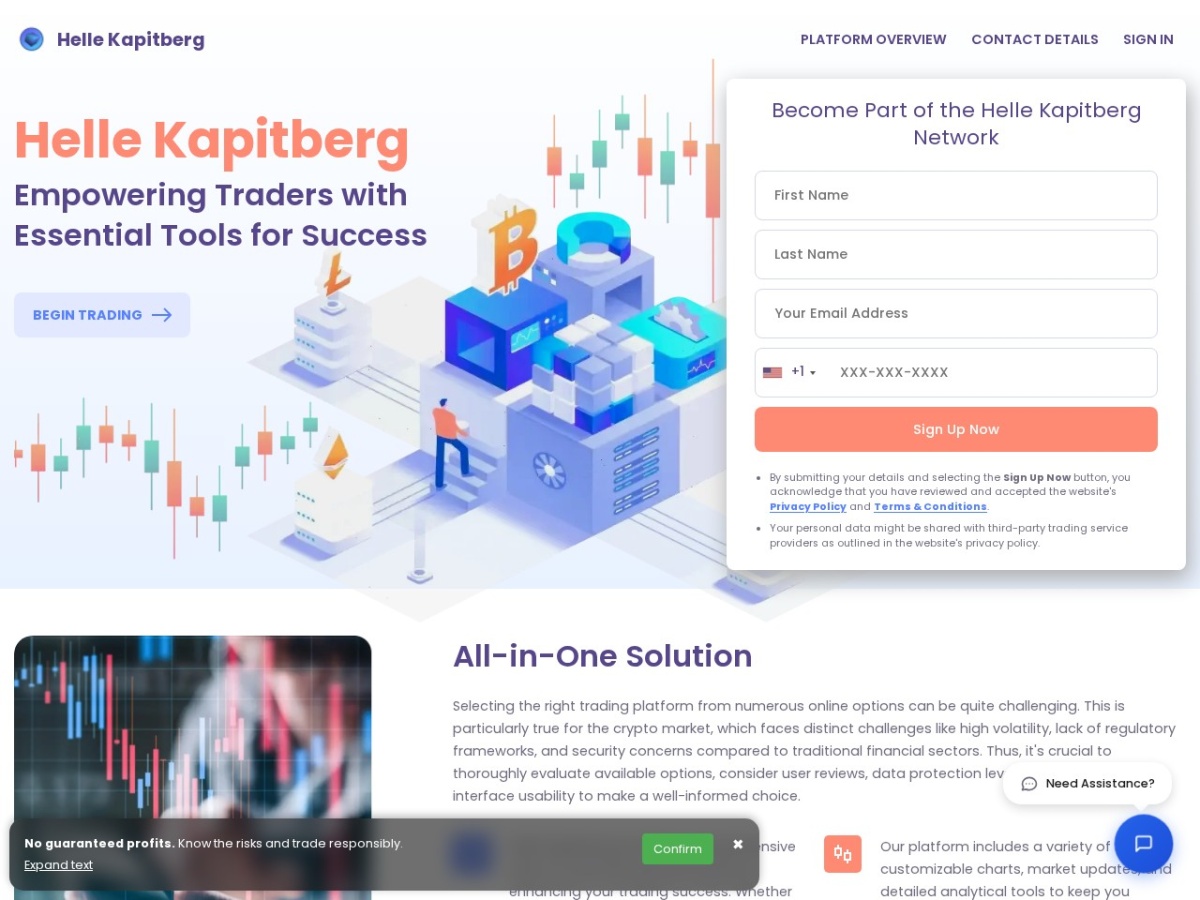
The cryptocurrency trading platform landscape has become increasingly crowded, with new names emerging almost weekly. Some offer genuine innovation, while others fade into obscurity or worse. Helle Kapitberg is one of those platforms that sits uncomfortably in the middle—presenting a professional facade and a suite of tools that, on paper, sound compelling, yet raising enough questions to warrant serious scrutiny before anyone commits real capital.
As an independent journalist who has covered fintech and crypto markets for years, I've learned to approach these platforms with healthy skepticism. The crypto space remains lightly regulated in many jurisdictions, making it fertile ground for both legitimate startups and operators with more questionable intentions. Helle Kapitberg presents an interesting case study because it doesn't immediately scream scam, nor does it inspire complete confidence. This review examines what the platform claims to offer, where it shows promise, and where red flags appear.
The Platform's Core Proposition
Helle Kapitberg positions itself as an all-in-one solution for cryptocurrency traders, targeting both beginners and experienced investors. The central pitch revolves around comprehensive charting tools, real-time market data, educational resources, and round-the-clock customer support—elements that any serious trading platform should provide. The company emphasizes the volatility and regulatory uncertainty inherent in crypto markets and frames its offering as a stabilizing force in that chaos.
On the surface, this makes sense. The crypto market is notoriously difficult to navigate. Price swings can be dramatic and sudden. The learning curve for technical analysis is steep. Many platforms offer barebones functionality and leave users to fend for themselves. If Helle Kapitberg genuinely delivers on its promises of comprehensive support, accessible education, and robust analytical tools, it could fill a real gap in the market.
The platform highlights customizable candlestick and bar charts, histogram analysis for price distribution, multi-monitor support, and personalized interface layouts. These are not revolutionary features—established platforms like TradingView and various brokerage interfaces have offered similar functionality for years—but their presence suggests at least an attempt to compete on functionality rather than pure marketing hype.
What Raises Eyebrows
While the feature list sounds reasonable, several aspects of Helle Kapitberg's presentation and structure raise concerns that any potential investor should consider carefully.
First, the platform's website and promotional materials use language that is simultaneously vague and grandiose. Phrases like "empowering traders with essential tools for success" and "comprehensive support system" are marketing speak that could apply to almost any platform. There is little concrete detail about the company's regulatory status, its physical location, who owns it, or how long it has been operating. In an industry where transparency is already scarce, this opacity is troubling.
Second, the registration process as described appears unusually streamlined. While ease of use is generally positive, excessively simple onboarding—especially for financial platforms handling real money—can be a warning sign. Legitimate brokers and exchanges typically require thorough identity verification to comply with anti-money laundering regulations. If Helle Kapitberg collects only minimal personal information, as suggested, it raises questions about its regulatory compliance and the protections available to users.
Third, there is the matter of third-party data sharing. The platform's terms acknowledge that personal data might be shared with third-party trading service providers. This is not unusual in the fintech world, but it does introduce additional risk. Users should understand exactly who these third parties are, what data is shared, and how it is protected. Without clear answers, users are essentially trusting not just Helle Kapitberg, but an unknown network of partners.
Fourth, the emphasis on community engagement and shared trading strategies can be a double-edged sword. While peer support and information sharing can be valuable, such communities can also become echo chambers for poor decision-making or, worse, coordinated pump-and-dump schemes. The platform's role in moderating and ensuring the integrity of these discussions is unclear.
The Educational and Support Angle
One area where Helle Kapitberg makes strong claims is education and support. The platform promises extensive resources for self-learning and continuous assistance from a support team available around the clock. If these claims are accurate, they represent a genuine value-add. Many traders, especially newcomers, struggle not because they lack access to markets, but because they lack the knowledge to interpret data and manage risk effectively.
The inclusion of demo accounts for risk-free strategy testing is another positive feature, assuming it functions as advertised. Paper trading allows users to familiarize themselves with the platform and test strategies without financial exposure, reducing the likelihood of costly beginner mistakes.
However, the quality of educational content and support is impossible to verify without firsthand experience. Many platforms advertise comprehensive education but deliver little more than generic blog posts and outdated videos. The true test is whether the support team can provide timely, knowledgeable assistance and whether the educational materials genuinely help users develop the skills needed for independent decision-making.
Market Analysis and Data Integrity
Helle Kapitberg emphasizes real-time data feeds and advanced indicators as central to its offering. In trading, data quality and speed are critical. Even slight delays can mean the difference between profit and loss, especially in volatile crypto markets. The platform's claim to provide fast order execution and up-to-date market information is important, but without independent verification or user testimonials from credible sources, it remains just a claim.
The platform also offers histogram analysis alongside traditional candlestick and bar charts. Histograms can provide useful insights into price distribution and trading volume, helping traders identify support and resistance levels or detect unusual market activity. However, these tools are only as good as the data feeding them and the trader's ability to interpret them. No amount of sophisticated charting can compensate for poor data quality or a fundamental misunderstanding of market dynamics.
The Risk Disclosure Problem
One of the more troubling aspects of Helle Kapitberg's presentation is how it handles risk disclosure. The platform acknowledges market volatility, security risks, regulatory uncertainty, and the potential for significant losses. These warnings are important and necessary. However, they are often buried in dense text or presented in a way that downplays their seriousness.
The crypto market is inherently risky. Prices can collapse overnight. Exchanges can be hacked. Regulatory crackdowns can render certain assets worthless or inaccessible. Even well-intentioned platforms can fail due to mismanagement or unforeseen technical issues. Any platform that does not make these risks absolutely clear—front and center, in plain language—is doing its users a disservice.
Moreover, the platform's emphasis on potential benefits such as faster transactions, enhanced security, and inflation protection can create an unbalanced picture. While blockchain technology does offer these advantages in theory, the reality is often more complicated. Transaction speeds vary widely between different cryptocurrencies. Security depends not just on blockchain protocols but on how exchanges and wallets are managed. And while some view crypto as a hedge against inflation, this remains a contested and unproven claim.
Regulatory and Legal Concerns
Perhaps the most significant red flag is the lack of clear information about regulatory oversight. Legitimate trading platforms are typically licensed and regulated by financial authorities in the jurisdictions where they operate. These regulators enforce standards for capital adequacy, client fund protection, transparency, and fair dealing.
Helle Kapitberg's promotional materials make no mention of regulatory licenses or oversight bodies. This absence is deeply concerning. Operating without proper licensing can mean that users have little recourse if something goes wrong—funds disappear, the platform shuts down, or disputes arise. In regulated markets, investors can often turn to ombudsmen or compensation schemes. In the unregulated wild west of crypto, such protections are rare or nonexistent.
The platform's privacy policy mentions sharing data with third parties, but there is no clarity on whether these parties are also regulated or what standards they must meet. In the European Union, for example, data protection regulations impose strict requirements on how personal information is handled. In other jurisdictions, standards may be far laxer, exposing users to privacy violations or identity theft.
The Community and Social Proof
Helle Kapitberg promotes an active community of traders who share strategies and market insights. Community engagement can be a valuable resource, offering diverse perspectives and collective wisdom. However, it can also be a tool for manipulation. In unmoderated or poorly moderated forums, misinformation can spread rapidly. Inexperienced traders may follow bad advice, amplifying their losses.
Moreover, the existence of a community does not, in itself, validate a platform. Scam operations have been known to cultivate online communities to create an illusion of legitimacy and social proof. Positive testimonials can be fabricated or incentivized. Without independent verification, user reviews and community endorsements should be taken with a large grain of salt.
Technical and Operational Transparency
A legitimate trading platform should be transparent about its technical infrastructure, security measures, and operational processes. Users should know how their funds are held, whether cold storage is used for cryptocurrencies, what cybersecurity protocols are in place, and how the platform protects against hacking and fraud.
Helle Kapitberg's materials emphasize security but provide few specifics. Generic assurances about blockchain security are not sufficient. Users need to know whether the platform employs two-factor authentication, encryption standards, regular security audits, and insurance against breaches or losses.
Similarly, the platform's order execution claims should be backed by verifiable performance metrics. Slippage, latency, and execution quality are all critical factors in trading. Without transparent reporting on these metrics, users are left in the dark about whether they are getting the best possible prices and execution speeds.
The FOMO Factor and Psychological Manipulation
One passage in Helle Kapitberg's promotional content warns against the fear of missing out, or FOMO, a common psychological trap in trading. Ironically, the platform's own marketing can contribute to this phenomenon. By emphasizing rapid market changes, the need for quick action, and the availability of unique analytical tools, the platform creates a sense of urgency that may pressure users into hasty decisions.
This is a subtle but important point. A responsible platform should encourage deliberate, informed decision-making rather than impulsive trading. Education and support should focus on long-term strategy, risk management, and emotional discipline, not on exploiting psychological vulnerabilities for short-term engagement.
Who Might Benefit and Who Should Be Wary
If Helle Kapitberg delivers on its promises—comprehensive tools, quality education, responsive support, and robust security—it could be a valuable resource for traders who lack access to these features elsewhere. Beginners who need guidance, intermediate traders seeking better analytical tools, and even experienced investors looking for a consolidated platform might find value here.
However, several groups should approach with extreme caution. Those new to investing in general should understand that even the best platform cannot eliminate market risk. Crypto is not a shortcut to wealth, and losses can be swift and severe. Those in jurisdictions with strict financial regulations should verify that Helle Kapitberg is licensed to operate legally where they live. And anyone uncomfortable with the lack of transparency around ownership, regulation, and third-party partnerships should consider whether the risks outweigh the potential benefits.
The Verdict: Proceed with Eyes Open
So, is Helle Kapitberg a scam or legit? The answer is frustratingly uncertain, and that uncertainty itself is a kind of answer. A platform that cannot or will not provide clear information about its regulatory status, ownership, security measures, and operational track record is asking users to take a significant leap of faith.
This does not necessarily mean Helle Kapitberg is a scam. It may be a relatively new or under-resourced operation that has not yet achieved the level of transparency and regulatory compliance expected of established players. It may be operating in a grey area, legally but not optimally. Or it may be a more sophisticated operation that deliberately avoids scrutiny.
What is clear is that anyone considering using Helle Kapitberg should do so with full awareness of the risks. Start small. Do not deposit funds you cannot afford to lose. Test the platform's support and withdrawal processes before committing significant capital. Look for independent user reviews, and be skeptical of overly positive testimonials that lack detail or verification.
Ultimately, every investor must take responsibility for their own decisions. No platform, no matter how polished its marketing or comprehensive its features, can protect you from your own lack of due diligence. The crypto market is unforgiving, and the platforms that serve it range from the exemplary to the exploitative. Helle Kapitberg falls somewhere in between—promising enough to warrant consideration, but uncertain enough to demand caution.
For now, the platform looks plausible and offers features that could genuinely support traders. But plausibility is not proof, and in the absence of transparent evidence, caution must be the guiding principle.
---
The facts and data referenced in this article were provided by Helle Kapitberg. All analysis, opinions, and conclusions are those of the author and do not constitute investment advice. Readers are encouraged to conduct their own research and consult with financial professionals before making any investment decisions.