
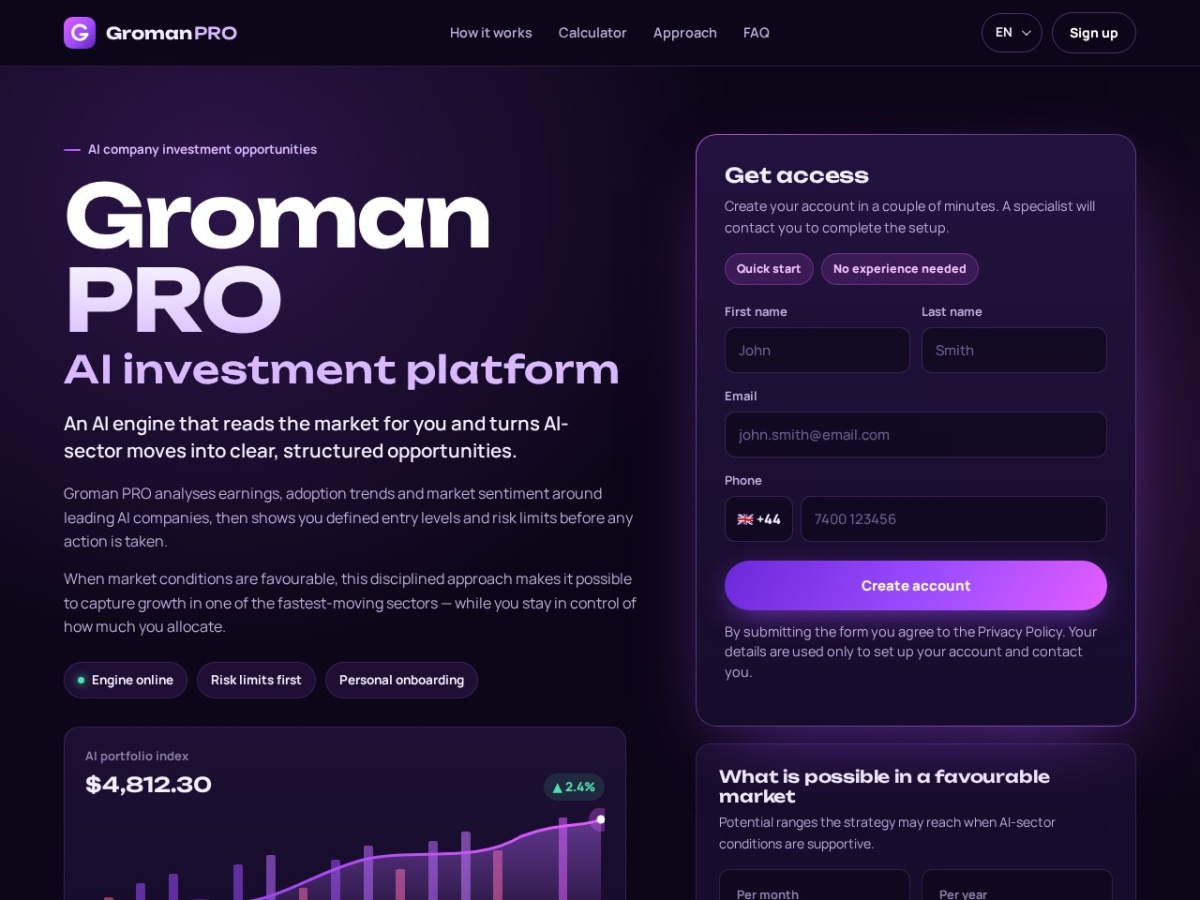
The promise of artificial intelligence has moved from hype cycles and research labs into the ledgers of publicly traded companies, venture portfolios, and now, platforms designed to give individual investors structured access to the sector. Groman PRO positions itself as exactly that: an AI-powered engine that scans market data, identifies opportunities among AI-focused companies, and executes positions within predefined risk limits. The pitch is deliberate rather than sensational—clarity over complexity, discipline over impulse. But in a space crowded with platforms offering automated trading and algorithm-driven strategies, it's worth examining whether Groman PRO stands on solid ground or simply dresses up familiar risks in fresh language.
The Core Proposition: Market Access Through Automated Analysis
Groman PRO is not a hands-on trading platform in the traditional sense. It doesn't invite you to pick stocks, build watchlists, or time entries yourself. Instead, the entire workflow is driven by an AI system that continuously monitors market activity around companies involved in AI development, adoption, and infrastructure. According to the company, the engine processes earnings announcements, adoption trends, sentiment data, and liquidity conditions in real time, then generates signals when certain criteria are met. Those signals translate into structured opportunities with defined entry points and risk limits that are set before any capital is committed.
The intended user is someone who doesn't have the time, experience, or inclination to actively manage investments but who still wants exposure to a high-growth sector. Groman PRO handles the routine work—monitoring, filtering, execution—while you set the parameters: how much to allocate, what level of risk you're comfortable with, and when to adjust. A personal specialist guides you through the initial setup and remains available as your account runs. The entire process is designed to remove emotional decision-making and replace it with a repeatable, rules-based approach.
That's the promise. The question is whether it holds up under scrutiny.
AI Markets in Numbers: Context for the Opportunity
Groman PRO grounds its strategy in a specific corner of the market: companies whose business models are tied, directly or indirectly, to artificial intelligence. The figures the platform cites are substantial. It references a combined AI market scale of around four point eight trillion dollars over a twelve-month period, with growth of roughly six hundred ninety billion dollars across segments. Within that umbrella, the company breaks down three categories: AI leaders valued at three point four trillion dollars and growing by thirty-one percent, AI growth companies at one point eight trillion dollars with twenty-seven point six percent growth, and AI infrastructure at one trillion dollars, expanding by forty-two point three percent.
These are large numbers, and they reflect real momentum. The AI sector has seen capital inflows, product launches, enterprise adoption, and significant investor attention. But those same dynamics also bring volatility. Interest rate shifts, sentiment swings, and liquidity changes can all turn a favourable market into a challenging one quickly. Groman PRO acknowledges this openly. The platform does not promise that conditions will always be supportive, and it includes risk warnings throughout its materials. The strategy model it presents is explicitly labelled as illustrative of favourable conditions, not a forecast or typical result.
That level of transparency is important. Many platforms in this space lean heavily on best-case scenarios without adequately emphasising downside risk. Groman PRO, at least in its public-facing content, does not oversell. It states clearly that actual results depend on market conditions and can be lower, including losses. That's a good sign, though it doesn't eliminate the need for investors to understand what they're getting into.
How the Engine Actually Works
The technical architecture is described in straightforward terms. Market data feeds into the AI engine with sub-second latency. The system applies filters for liquidity, stability, and risk, then flags setups that meet its predefined criteria. If a signal passes those filters, the platform calculates position size and sets protection levels—stop-loss thresholds, essentially—before executing the trade. The engine monitors positions continuously and adjusts or closes them as market conditions change.
This is a classic quantitative workflow, automated and rule-driven. It's not revolutionary in concept, but that doesn't make it ineffective. What matters is whether the rules are sound, whether the filters are calibrated correctly, and whether the risk controls are enforced consistently. Groman PRO claims ninety-nine point nine percent uptime and twenty-four-seven market monitoring, which suggests robust infrastructure. The workflow is described as traceable: every signal, every decision, every execution is logged and visible within the platform.
That transparency is crucial. In algorithmic trading, the black box problem—where users have no idea why a decision was made—is a common criticism. Groman PRO appears to address that by linking analysis, execution, and risk management in a single, auditable process. You can see why each action was taken, from the first signal to the final position. If that claim holds true in practice, it's a meaningful differentiator.
The Strategy Model: What Favourable Looks Like
Groman PRO presents a model scenario for a twelve-month period under supportive AI-sector conditions. The figures are illustrative, not promises. In this scenario, a portfolio starting with seventeen thousand two hundred dollars grows to twenty-five thousand eight hundred dollars, a fifty percent return. The best month in the model shows a fifteen percent gain. Eight out of twelve months are positive, two are flat, and the annual range is described as eighty to one hundred fifty percent in favourable cycles.
These are aggressive numbers. They reflect a high-growth environment where momentum is strong, sentiment is positive, and volatility works in the strategy's favour. But they also highlight the platform's risk profile. If eight months are positive and two are flat, that leaves room for difficult months. The platform doesn't hide that. It notes clearly that in weaker markets, the picture can look very different.
This is where investor psychology becomes critical. A fifty percent return in a favourable year sounds attractive, but if the market turns, the same strategy could deliver flat or negative results. Groman PRO's model assumes favourable conditions, which by definition cannot be guaranteed. The platform's risk warnings are explicit, but it's still easy for a casual reader to focus on the upside and underestimate the downside.
Who Should Use This, and Who Shouldn't
Groman PRO is explicit about who it's for and who it's not. It suits investors who prefer a guided, technology-led process over active, hands-on trading. It's designed for people who don't have time to monitor markets daily, who are new to investing, or who want to avoid impulsive decisions driven by emotion or short-term noise.
It's not for investors who want to place and manage every trade themselves, who prefer high-risk speculation with no guardrails, or who expect instant results. The platform is clear on this point, and that honesty is refreshing. Too many platforms try to be all things to all users. Groman PRO draws clear boundaries.
That said, the platform's target user—someone new to investing, looking for a structured approach—is also the user most vulnerable to misunderstanding how the strategy works. The risk here is not that Groman PRO is misleading, but that inexperienced investors may not fully grasp the implications of market-dependent returns, even when those risks are disclosed.
Onboarding and Support: A Guided Start
One of Groman PRO's distinguishing features is its emphasis on personal onboarding. After registration, which is described as taking about two minutes, a specialist contacts you to confirm details, explain the platform, and guide you through the initial setup. You choose the amount you want to allocate and your preferred risk level, and the engine takes over from there.
This human layer is important. It adds friction in a good way, ensuring that users don't simply sign up, deposit funds, and start running a strategy they don't understand. The specialist serves as both a gatekeeper and a guide, providing context and answering questions before the engine goes live.
Whether this onboarding is genuinely educational or primarily a sales touchpoint is something only users can judge after going through the process. But the presence of a dedicated contact, rather than a purely self-service flow, is a positive signal.
Transparency and Risk Controls: The Make-or-Break Factor
The platform's design revolves around transparency and predefined risk limits. Position sizes are calculated before execution. Stop-loss levels are set automatically. The engine re-evaluates positions as conditions change. The workflow is traceable, and users can see the logic behind each decision.
These are all sound practices, but they depend entirely on execution. If the risk controls work as described, Groman PRO offers a disciplined, rules-based approach to a volatile sector. If they don't—if stops are set too wide, if filters let through low-quality signals, if the engine doesn't adapt quickly enough to changing conditions—then the platform's entire value proposition falls apart.
This is the crux of the scam-or-legit question. A scam would make promises it has no intention of keeping, hide fees, misrepresent returns, or operate without proper oversight. Groman PRO, based on its public materials, does none of those things. It discloses risks, provides illustrative scenarios rather than guarantees, and emphasises that results depend on market conditions.
But legitimacy is not the same as success. A platform can be transparent, well-intentioned, and still deliver disappointing results if its strategy underperforms or if market conditions turn unfavourable. That's not fraud—it's just the nature of investing.
The Verdict: Structured Access, Not a Magic Formula
Groman PRO presents itself as a tool for disciplined, AI-assisted exposure to a high-growth sector. It does not promise guaranteed returns. It does not hide risk. It does not pretend that investing in AI companies is without volatility. What it offers is a structured process, backed by automation and supported by personal guidance, for investors who prefer rules over guesswork.
Is it a scam? Based on the available information, no. The platform is transparent about its model, its risks, and its limitations. It provides clear warnings that returns are market-dependent and can include losses. It does not make unrealistic promises or bury important details in fine print.
Is it legitimate? It appears to be. The workflow is described in detail, the risk controls are outlined, and the onboarding process includes human support. The platform operates with high uptime, real-time monitoring, and traceable execution.
Does that mean it will deliver the returns shown in its model scenarios? No. Those scenarios are illustrative of favourable conditions, not predictions. Actual performance will depend on how well the AI engine adapts to real market conditions, how effectively risk controls are enforced, and how the AI sector itself performs over the period you're invested.
The responsibility ultimately lies with the investor. Groman PRO provides the tools, the structure, and the transparency. But it cannot control the market, and it cannot guarantee outcomes. If you're considering the platform, take the time to understand how the strategy works, how much you can afford to lose, and whether a disciplined, AI-driven approach aligns with your investment goals.
This is not a magic formula. It's a structured method for accessing a volatile, high-potential sector. Used wisely, with realistic expectations and proper risk management, it could be a valuable tool. Used carelessly, or with expectations shaped by best-case scenarios, it could disappoint.
The facts and data for this article were provided by Groman PRO, and you can explore the platform in detail at https://groman.pro/, which served as the source for all figures, descriptions, and model scenarios referenced throughout this review.